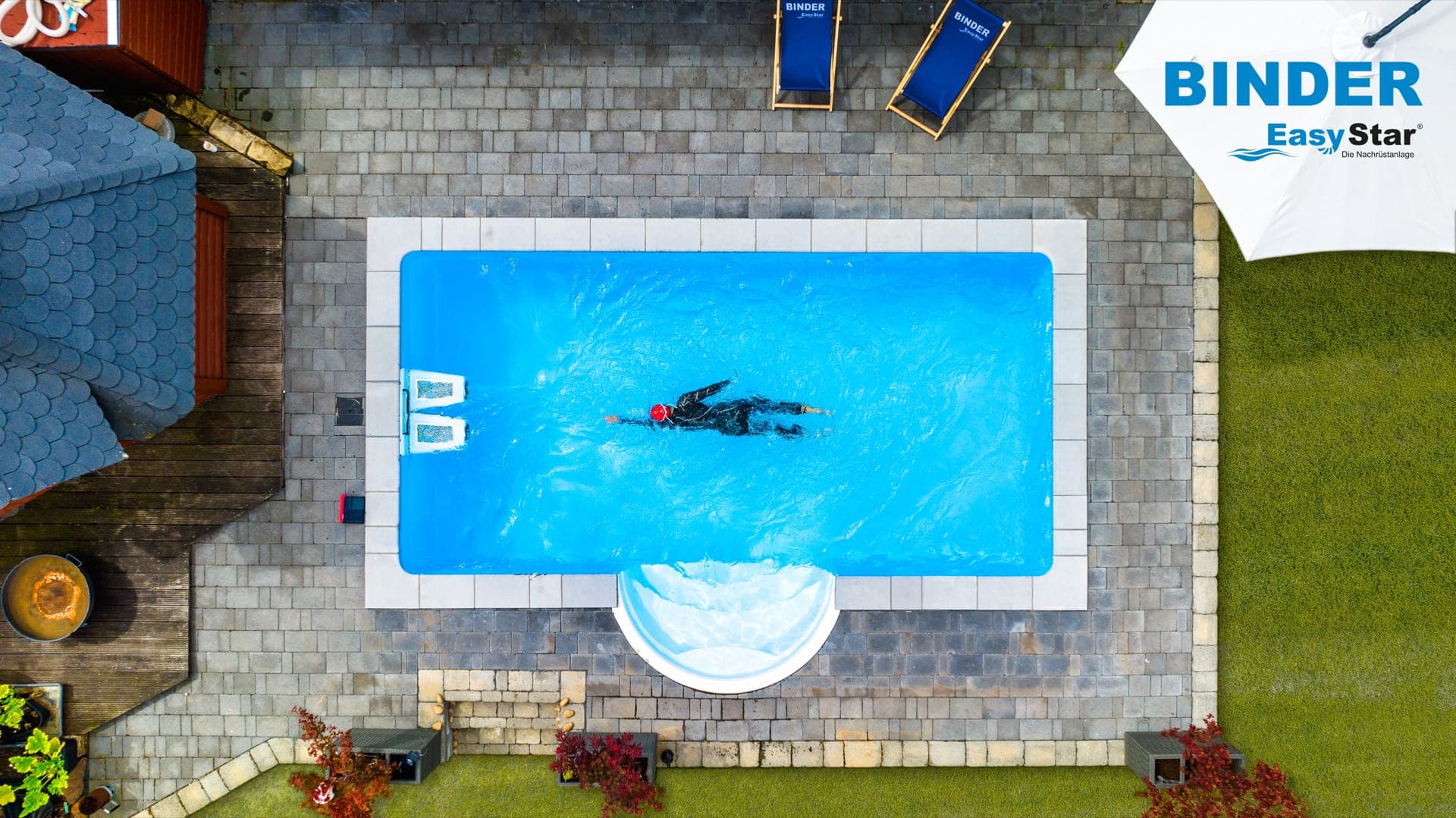
What does a Binder counter-current transformation actually look like for a Cyprus villa pool?
For a typical Cyprus villa pool — roughly 8 × 4 m, tiled, sitting on a terrace that faces the garden or the sea — a counter-current transformation means fitting a Binder EasyStar retrofit turbine (or, on new builds, a HydroStar behind-the-wall unit) so the pool produces a wide, adjustable river-like current you can genuinely swim against. Most retrofit projects are half a day to one day on-site, with no draining, no tile cuts, and no high-voltage works. The pool looks unchanged. The way you use it changes completely.
This article is a composite walkthrough, not a real customer story. Reon Living's /installs hub is intentionally empty until we have named clients with written permission to publish photos and details — we would rather show nothing than invent testimonials. Every pool size, phase, and timeline below describes a typical Cyprus villa project, the kind we quote most weeks. Nothing here is attributed to a named person, address, or property.
The Cyprus villa pool we keep quoting for
If you have lived on the island long enough, you know the pool we mean. It was built between the mid-2000s and today. It sits on a terrace that faces either the sea or a walled Mediterranean garden. The coping is travertine or a pale limestone, the waterline tile is a soft blue or a bottle green, and the shell is rectangular — usually 7 × 3.5 m, sometimes 8 × 4 m, occasionally 10 × 5 m for the larger villas around Limassol and Paphos. It was designed, first and foremost, to look beautiful from the living room.
It was not designed to be swum in for exercise. Three strokes and you reach the wall. Four strokes and you are already rehearsing a tumble turn you did not come on holiday to perform. Between May and October the pool is in constant use for cooling off, for children, and for evening drinks — but the owner, who quietly wants to do twenty minutes of proper lap swimming every morning, has essentially given up and joined a gym in Nicosia instead.
That is the starting point of almost every project we discuss. The pool is not the problem. The length is the problem. And the transformation is about giving that pool a second job without touching the thing that makes it beautiful.
What "transformation" actually means here
A Binder counter-current system replaces the wall with a river. The turbine pushes a wide, laminar column of water along the swim lane — up to several hundred cubic metres an hour on HydroStar, up to 430 m³/h on the mid-range EasyStar units — and you swim into it at a speed you set yourself, continuously adjustable from a gentle aqua-walk to genuine race pace. There is no cable, no tether, no bungee, no jet-pack sensation of being blasted sideways. The water feels like open water. You swim in place.
For a Cyprus villa owner that is the transformation: the 8-metre rectangle becomes, functionally, an infinitely long lane. Everything else about the pool — the finish, the tile, the coping, the view, the evening atmosphere — stays exactly as the architect drew it.
Two paths: retrofit and new build
Most projects we discuss fall into one of two scenarios. They have very different phase structures.
A representative retrofit week, step by step
Here is how a representative EasyStar retrofit on a Cyprus villa pool unfolds. Treat the timings as typical rather than guaranteed — the actual calendar depends on model availability and your scheduling.
Day zero — first contact. The owner sends us photos of the pool from three angles and the dimensions on the back of an envelope. Within a day we confirm whether it is a candidate at all. The retrofit guide covers the hard limits: 5 m minimum length, 2.5 m minimum width, dry space for the control unit, and a standard 230 V supply within cable reach.
Week one — site visit. A 45–90 minute visit at the villa. We measure the coping profile, check the overflow channel if there is one, look at where the control unit can live (often a pump room, a dry storage cupboard, or a discreet corner of the technical area), and confirm the electrics. We are also looking for things that would complicate the install: fragile coping stones, failing tile beds, unusual pool geometries. If any of that shows up, we flag it in writing before quoting.
Weeks one to two — quote and model selection. The EasyStar family runs from BGA 160 to BGA 550; for a typical villa pool we usually specify BGA 215 or BGA 275. Larger pools or multi-swimmer households sometimes justify BGA 320. The quote is itemised and fixed — equipment, bracket, installation, commissioning, VAT — and we put the warranty and service terms on the same page.
Weeks two to six — lead time. Binder ships from Germany. We order, we track, and we schedule the install date around the owner's calendar. Most Cyprus owners prefer a weekday outside peak summer.
Install day. One team, one vehicle, one pool day. The bracket hooks over the pool edge, the turbine is fitted, the control unit is mounted and wired to the existing 230 V circuit, and the pool runs a commissioning cycle while the installer is still on-site. We tune flow with the owner in the water — low, medium, and full — and pair the remote. The tiles, the coping, the shell, the pipework, and the filtration are untouched.
The next morning. The owner swims laps in their own pool for the first time. This is the part of the job we will not get to photograph, because it is private. It is also the part the work is for.
A representative new-build integration
New-build projects have a completely different rhythm. The counter-current system is specified before the concrete is poured, not bolted onto a finished pool. In practice, that means:
- The architect or pool builder contacts us during the design phase.
- We review the pool drawings and specify a HydroStar unit sized to the pool, the intended swim profile, and the filtration scheme.
- Binder's installation shaft is designed into the wall section. The turbine, electronics, and service access are all hidden behind the pool wall, invisible from the terrace.
- Commissioning happens with the pool's first fill. The owner's walkthrough is part of the handover.
There is no "disruption" to talk about because the system is part of the build, not an interruption to it. The visible outcome is a pool that looks like an ordinary beautiful rectangle and performs like a 50-metre lane.
What changes after the transformation — and what doesn't
What doesn't change: the look of the pool, the tiles, the coping, the view, the evening atmosphere, the way children use it, the filtration, the heating, the way the pool builder's original warranty works. A well-specified counter-current system is something guests notice only if you switch it on.
What changes: the owner stops joining a gym in Nicosia. Morning laps become a routine. Rehab and low-impact water fitness become possible without leaving the property. The pool stops being a decorative feature you occasionally swim in and starts being a daily training tool that also happens to be beautiful. For a lot of Cyprus villa owners that is the single highest-leverage upgrade they make to the house in a decade.
A note on honesty
Reon Living publishes real, named case studies as soon as clients give written permission — photos, pool dimensions, and all. Until then, the /installs hub stays intentionally empty. We would rather show nothing than invent a story, and Google's helpful-content signals agree with us on that one.
If you want to talk about a specific villa — yours — we can do that properly. Contact us with photos and dimensions and we will tell you honestly whether it is a candidate, which Binder model fits, and what the scope would actually look like on your terrace.
Related reading
- Can I retrofit a Binder counter-current system into an existing pool? — the hard constraints behind the EasyStar retrofit path.
- How much does a counter-current pool cost in Cyprus? — the honest price ranges we quote.
- The full Binder range at a glance — HydroStar, EasyStar, LittleStarlet compared.
- All installations and case studies — real named projects as soon as clients give permission.