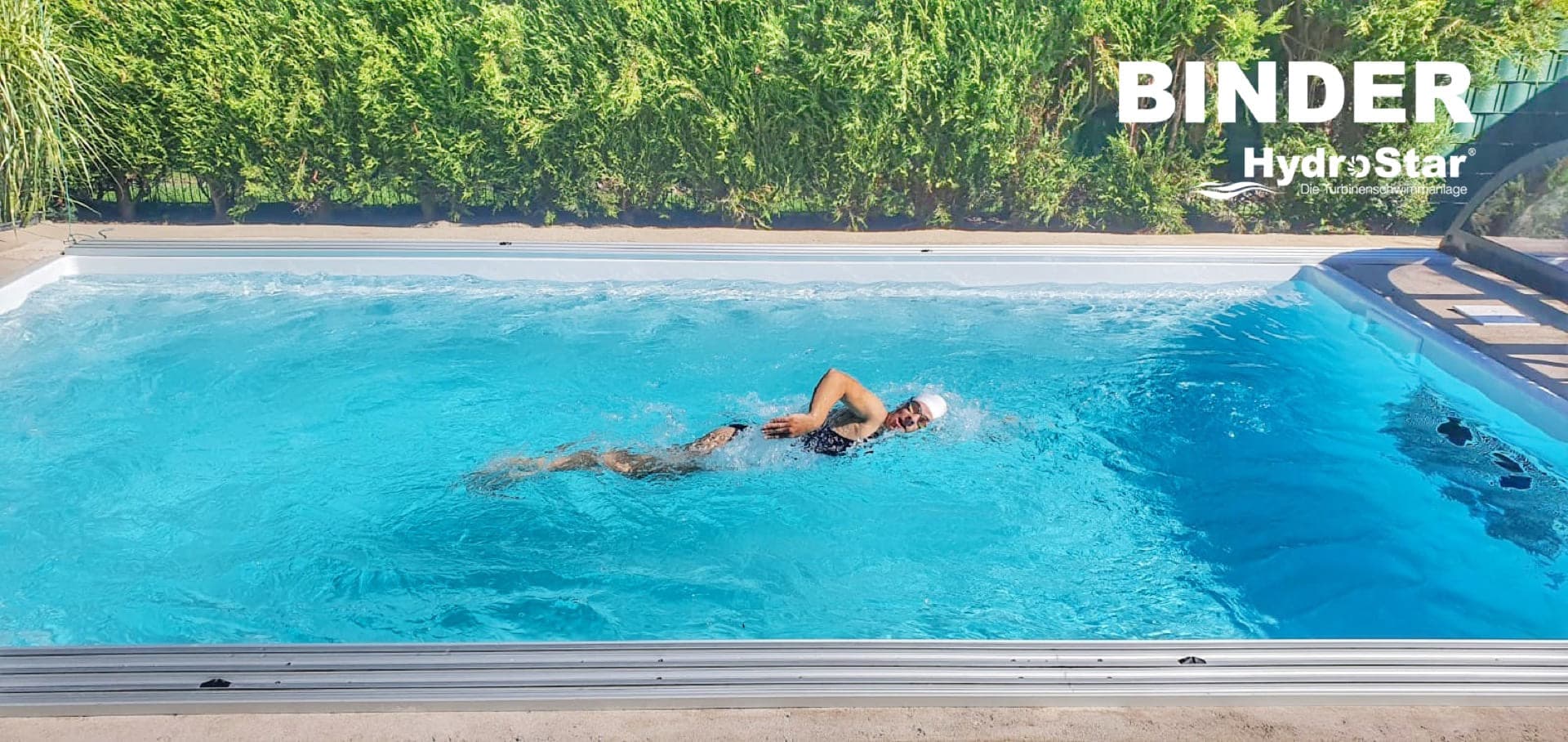
How much pool length do you actually need for serious swim training at home?
For continuous freestyle with flip turns that feel natural, you realistically want a pool of around 25 m — the standard short-course length used by competitive swimmers worldwide. Most Cyprus villa pools are 6 to 12 m, which means you would be turning every three or four strokes and never settling into a rhythm. For villa-scale pools, the practical answer is a counter-current system: it moves the water past you at a controlled speed, turning any pool into an infinite lane for as long as you want to swim.
Why pool length matters for real training
A "training swim" is not just time in the water. It is sustained continuous effort at a chosen intensity, long enough for your cardiovascular system, your stroke mechanics and your breathing to settle into a steady state. Competitive swim culture is built around that idea: 200 m repeats to hold threshold, 400 m pulls to build aerobic base, longer continuous sets to develop the ability to hold form when tired. None of that survives a pool where you turn every four seconds.
Flip turns themselves are part of the problem and part of the solution. In a real 25 m pool, a turn is a brief tuck-and-push that refreshes your position without breaking effort. In a 6 m pool, turns dominate the set: you spend more time rotating off the wall than swimming, and every push-off masks how your stroke actually feels. It becomes exercise, not training.
This is the gap a counter-current system closes. Instead of lengthening the pool, you move the water. A strong, flat, stable column of flow lets you hold position and swim continuously — 10, 30, 60 minutes — without a single turn. The pool's physical length stops mattering.
Cyprus villa pools: the real starting point
Villa pools across Cyprus tend to cluster around the same shape. A private pool at a house in Limassol, Paphos, Larnaca or a Protaras villa is typically somewhere between 6 and 12 m long and 3 to 5 m wide. That size is driven by plot geometry, planning, heating cost and the way most families actually use a pool: for cooling off, hosting, and keeping children happy.
What that pool is not sized for is continuous lap swimming. A competitive triathlete training for Ironman Cyprus, a masters swimmer holding base fitness over winter, or a lifelong swimmer who just wants honest 45-minute sets cannot get that work done by turning every fourth stroke. And yet Cyprus has one of the best climates in Europe for outdoor swim training: with a heated pool the season is effectively year-round, and the triathlon and open-water community on the island is growing every year.
That combination — small villa pools plus a long training season plus a real athletic population — is exactly the situation counter-current systems were designed for.
Pool length vs training use-case
The table below gives a rough, honest mapping from pool length to what that pool can realistically do without a counter-current turbine. It reflects the numbers most coaches and swim clubs use as rules of thumb, not a Reon measurement.
The honest conclusion: anything under roughly 25 m is not a training pool without help. And 25 m is already longer than the great majority of private pools in Cyprus.
The simplest way to think about it: pool length sets a ceiling on how long you can swim before a turn interrupts you. A counter-current system removes the ceiling entirely. The pool becomes as long as your session is.
Why a counter-current system is the practical answer
A counter-current system works by accelerating a large volume of pool water through a turbine and releasing it as a wide, flat, laminar jet. You swim into that jet at a chosen speed and effectively stay still relative to the pool wall. The faster the flow, the faster you must swim to hold position. It is, in every way that matters for training, an endless lane.
The HydroStar is Binder's built-in, new-build system — the housing is cast into the pool wall, and only the intake and outlet grilles are visible. Its eight models cover a flow range from 50 to 1,200 m³/h, with maximum swim speeds up to 3.2 m/s. For context, elite 100 m freestyle is sustained at roughly 2 m/s for under a minute; 3.2 m/s is well above anything an age-group athlete will hold, and that headroom matters because it means HydroStar never becomes the bottleneck in your training. HydroStar works in pools from 4.5 m in length upward, and it is the system we point serious lap swimmers toward.
If you already have a pool you don't want to rebuild, the EasyStar is the retrofit answer. It bolts to the existing pool wall on a bracket rather than being cast in, and it covers 50 to 550 m³/h across six models — more than enough for home athletes. Minimum pool length is 5.0 m.
Both systems are variable-speed, so the same unit serves gentle family swimming and hard threshold sets. This is where Binder's European build shows up: the turbines are BLDC, the hydraulics are engineered for smooth laminar flow rather than turbulent froth, and the warranties reflect it — three years on HydroStar, extendable to seven. You can read more about the engineering logic on why Binder, and the full Binder range is on the products page.
The honest trade-offs
Counter-current training is not identical to a 50 m pool. Three things are genuinely different. First, you never push off a wall, so you lose the brief micro-recovery of a turn — meaning a continuous counter-current swim is slightly harder per minute than the equivalent pool set, which is a feature not a bug. Second, sighting practice for open-water triathlon still needs occasional sessions in the sea or a proper long-course pool. Third, mass-start contact practice obviously cannot be reproduced.
Everything else — aerobic base, threshold work, stroke efficiency, catch and rotation drills, kick sets, technique filming, warm-downs, long easy swims — happens as well or better in a well-specified counter-current pool than it does in a short villa lane with constant turns.
FAQ
Can I really train for a triathlon or Ironman in a 6 m pool? Yes, for the swim leg, provided you have a counter-current system strong enough to hold race pace. A HydroStar delivering up to 3.2 m/s exceeds the speed any age-group triathlete will sustain, so the limiter becomes your fitness, not the pool. You still want occasional open-water sessions for sighting and contact practice, but the conditioning and threshold work can happen entirely at home.
Is swimming against a current really the same as swimming in a pool? Biomechanically it is closer than people expect. Your stroke, kick, breathing pattern and effort curve are the same. What changes is that you never push off a wall, so you lose the brief recovery of a turn. That makes counter-current swimming slightly harder per minute than equivalent pool work — useful if anything, not a drawback.
What about technique work and drills? Counter-current systems are excellent for technique. The water is consistent, you stay in one place, and a coach at the pool edge can watch a full stroke cycle continuously rather than catching glimpses between turns. Underwater filming is easier too.
Are these systems good for kids and family swimming? Yes. Both HydroStar and EasyStar are variable-speed, so you can dial the current down to a gentle drift for children or up to full training pace for serious work. One pool, multiple uses.
Does the pool need to be heated? Not required, but for year-round training in Cyprus most owners heat the pool. Outdoor pools here are comfortable without heating from roughly May to October; a heat pump or solar warming extends that into a proper twelve-month training season.
Reon Living is the Cyprus distributor for Binder counter-current swimming systems. For advice on sizing a HydroStar or EasyStar to your pool and training goals, get in touch.