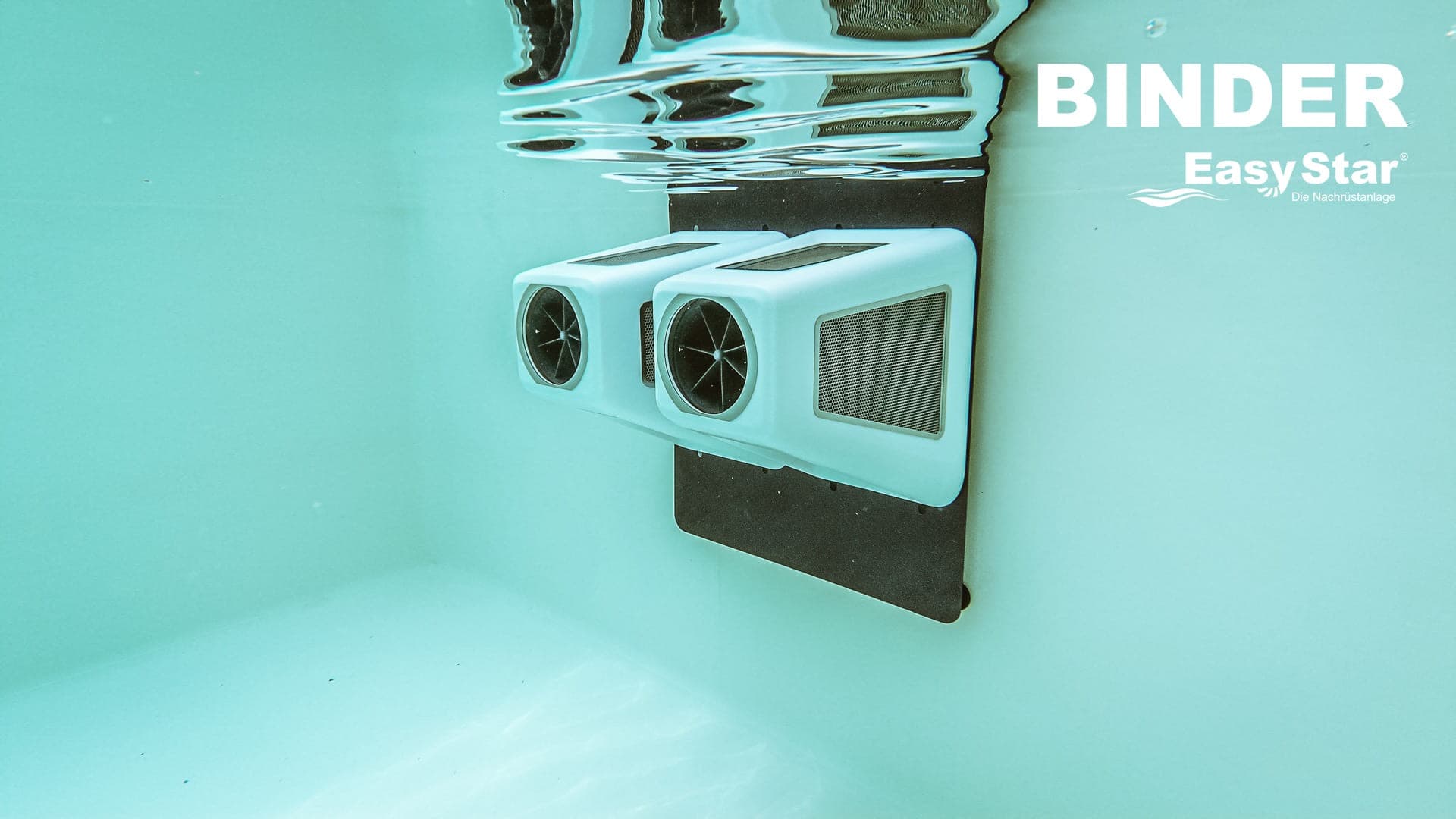
Turbine vs pump-jet — which actually feels better to swim against?
A turbine moves a wide column of water slowly and evenly, so swimming in it feels like a river. A pump-jet accelerates a small volume of water through a nozzle, so swimming in it feels like a narrow stream of water hitting you. Both will hold you in place. Only one lets you swim with correct technique for a full training session without constantly re-centring on the flow.
Every counter-current swimming system on the market is trying to solve the same problem: make a short pool behave like an endless one. How each system solves that problem is where they stop looking alike. There are really only two serious answers — a turbine or a pump-jet — and the difference between them is not a matter of brand preference or marketing language. It is a matter of physics, and you feel it in the first minute of the first swim.
This article is a category explainer. We are not naming competitor brands — we are comparing two design philosophies. Reon Living is the Cyprus distributor for Binder, a German manufacturer that has built turbine counter-current systems since 2003, so you should read this knowing where we stand. What follows is still accurate.
The two designs, in one paragraph each
A pump-jet counter-current system works like a fire hose. A high-pressure pump — often a three-phase industrial pump — pulls water in and forces it through a narrow nozzle, typically after redirecting the flow through a 90° elbow. The output is a concentrated, high-velocity stream. Because the cross-section is small, the stream has to move fast to generate enough force to hold a swimmer. Fast plus narrow equals turbulent.
A turbine counter-current system works like a river weir or a small hydroelectric turbine. A wide axial impeller rotates slowly inside an installation shaft and moves an enormous column of water forward in a broad, even flow. The cross-section is large, so the water does not need to move fast to generate equivalent push. Slow plus wide equals smooth. On Binder's HydroStar range, that wide column runs at 1.0–3.2 m/s and can move up to 1,200 m³/h on the largest PRO model, all from a single 230 V domestic supply.
Stand at the end of a pool with a turbine system running at half speed and put your hand in the water anywhere across the width of the flow. The push is roughly the same. Do the same thing on a pump-jet and you will find a hot spot — a narrow corridor where the stream is strong and immediately outside it, where the water is almost still. That is the difference you feel when you swim.
Why the feeling is so different
The reason a turbine feels like open water and a pump-jet feels like a stream hitting you is not style — it is energy distribution. A turbine converts rotational energy into linear flow along the axis you swim in. An axial impeller rotating in the direction of the swimmer keeps almost all of its energy moving forward. A pump-jet has to accelerate a smaller volume of water to a much higher velocity, then change its direction through a nozzle and usually an elbow. Every bend and every restriction is energy dissipated as heat, turbulence, and noise instead of forward push.
That is why a turbine-driven system can generate the same holding force as a pump-jet while drawing a fraction of the electricity. Binder publishes a direct worked example in their own product literature: a 15 kW pump-jet versus a 1.5 kW Binder turbine, run 100 days per year at 10 hours per day, at €0.40 / kWh. The pump-jet costs €6,000 per year to run. The turbine costs €600. That is not a small efficiency gain — it is an order of magnitude, and it is the physics of axial flow versus forced-nozzle flow doing the work.
The Cyprus angle — why smoothness matters more here
In Cyprus, a pool that has been built for swimming — not just cooling off — is a pool that gets used. Daily summer use, from late April through late October, is the baseline, not the exception. When you swim against a counter-current for 45 minutes every morning, tiny differences in flow quality compound into real physical cost. A narrow jet that forces you to re-centre every third stroke is annoying in a ten-minute test swim and exhausting in a 2 km set. A smooth turbine column lets you hold a line, breathe evenly, and finish the session with the same technique you started with.
There is also a practical electrical reason. A lot of private villas in Cyprus are fed with a single-phase 230 V supply. A Binder HydroStar runs on that supply with a 16 A inert fuse and an RCD — no three-phase upgrade, no utility-side change. Many pump-jet systems at comparable flow rates simply assume three-phase is available, which on an existing property is a project in its own right.
Side-by-side
FactBox
Where pump-jet is genuinely the right answer
Honest category explainers need an honest "other side" section, so here it is. A pump-jet is a legitimate choice when:
- The pool already has a pump-jet niche cast into the wall, the existing equipment is at end-of-life, and the owner does not want to reopen the wall. Replacing like-for-like is faster and cheaper than retrofitting a turbine, and if the pool is mainly used for cooling off rather than swimming, the category advantage is smaller. (If you do want to switch, a retrofit-friendly EasyStar is often the answer.)
- Swim sessions are short and occasional. If nobody in the household is ever going to swim more than five minutes at a time, the smoothness advantage of a turbine is partly wasted on you. You will still feel it, but you will not need it.
- Budget is the hard constraint and nothing else matters. Some budget pump-jets are cheaper to buy than a turbine system of equivalent flow — though, as Binder's worked example makes clear, the gap closes fast once you count electricity.
We do not think those use cases describe most serious private pool owners in Cyprus. But they exist, and pretending otherwise would be dishonest.
What to actually look at when you compare systems
If you are evaluating counter-current systems head-to-head, don't start with brochures. Start with four questions:
- What does the flow look like at the pool edge? Wide column or narrow stream? You can usually tell from a site visit to an installed unit, or from a dealer's test pool.
- What supply does it need? 230 V single-phase or three-phase? This alone can decide feasibility on an existing property.
- What is the full-speed-full-hour running cost? Multiply rated kW × your electricity tariff × realistic annual hours. Then compare.
- What fails, and when? Ask the dealer which component is the first to need service. If the honest answer is "the shaft seal" or "the pump impeller", you are looking at a traditional pump. If the honest answer is "nothing for years", you are looking at a seal-less turbine.
We wrote a longer treatment of the engineering behind question 4 on the Why Binder page, and every spec number on the Technology page is cited directly from Binder's own product documentation.
The short version
A counter-current pool is only as good as the current it produces. A turbine produces a river. A pump-jet produces a hose. Both of them will hold you in place — but only one of them lets you swim in the same pool for the next fifteen years without fighting the water, upgrading your electrical supply, or replacing a shaft seal. If the pool is for serious daily swimming, the category choice has been made for you by physics. If it isn't, the category choice matters less, and a pump-jet may be fine.
Either way, don't buy either category without feeling it first. Swim-testing is the one step that cannot be replaced by a spec sheet, and it is the one step that makes the difference between a pool you own and a pool you use.
Every Binder-specific number in this article — flow rates, kW ratings, the €600 vs €6,000 worked example, motor and warranty specs — is taken from Binder's own product documentation and published on our Technology page. We cite because we would rather you trust the source than trust us.